

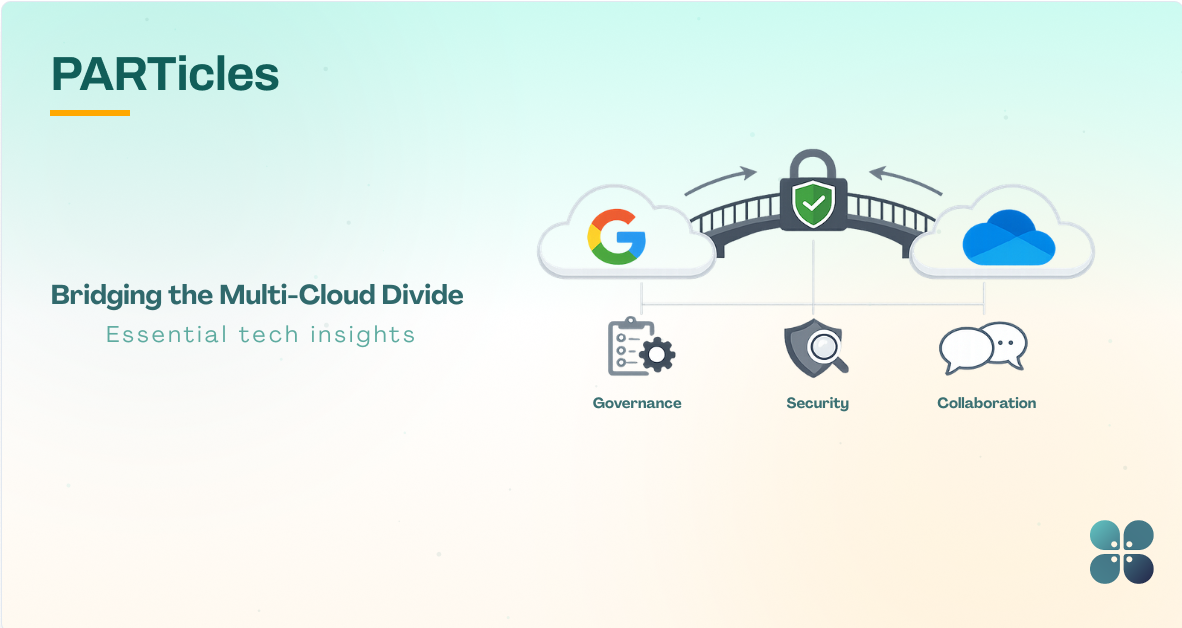
Organizations today are beginning to look at an emerging security concern that has been quietly growing behind the back of unstructured data growth across the board. The question isn’t whether we can operate across multiple cloud ecosystems or not, it's how we can stop them from becoming another security nightmare. Bridging these environments often leads to data silos, permission conflicts, and non-standard audit trails that are impossible to follow.
The good news is, we don't need a massive, expensive data migration. Instead, the solution lies in emerging products around Content Governance Frameworks and Private Content Networks. These act as secure "wrappers," allowing organizations to share data across firewalls without moving a single file from its original home.
We walk through three leading products and patterns organizations can consider adopting to address the growing concern of multi-cloud content sharing.
Managing a split ecosystem between Google and Microsoft no longer requires choosing a side in a "cloud war," as modern technology has moved toward a model of unified governance. High-level platforms now act as an overarching layer that sits directly on top of existing storage systems, providing a single entry point for all content. For example, some systems utilize an "air-lock" principle where they mount external drives so the master copy never actually leaves its native environment.
This allows organizations to maintain one unified audit trail for every external share, regardless of whether the file originated in OneDrive or Google Drive. Other hubs create a silent, unified file system that enforces security policies in the background, allowing for native co-editing across both platforms so the workflow remains uninterrupted.
For organizations that prefer not to change how employees work but still need to tighten security, the focus shifts toward the compliance and security perimeter. This is often achieved by extending specific sensitivity labels from one ecosystem into the other through dedicated connectors, ensuring that protection follows the data wherever it travels. Visibility is also a major factor in this layer, as modern posture management tools constantly monitor permissions across both clouds. This helps administrators identify "shadow access," such as sensitive project folders that may have been accidentally left open to external guests years prior.
Ultimately, the goal is to create a "single pane of glass" where the user experience takes center stage and files are accessible exactly where the work happens. Many modern chat and collaboration tools now feature external connectivity that allows teams to pull files from either cloud into a conversation without the need to switch tabs or manage multiple logins.
Emerging platforms are even bridging these environments specifically for external partners and vendors, streamlining the interface so they don't have to navigate two different systems just to find a single document. By leveraging these governance platforms, security frameworks, or collaboration hubs, businesses can finally ensure their teams work safely and efficiently across a hybrid cloud landscape.
